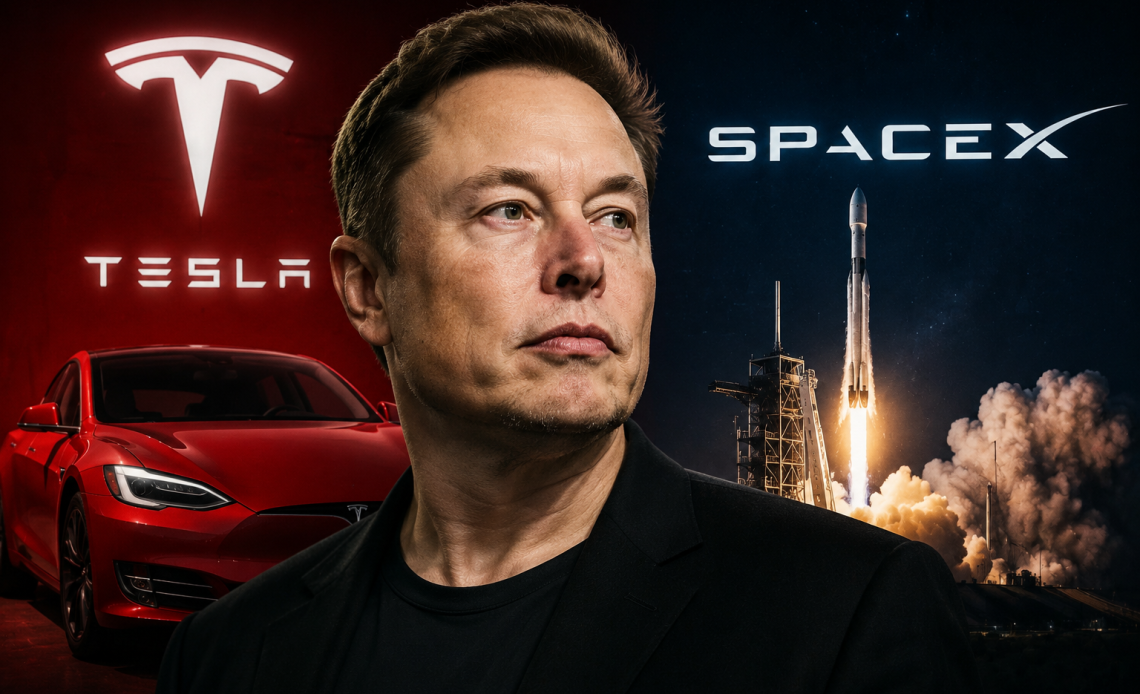
The countdown to SpaceX’s long-awaited stock market debut is entering its final days.
Sixteen years ago, Tesla went public on the stock market, and today, Elon Musk is preparing to take another company public, which is already larger, more ambitious, and arguably far more controversial from a valuation standpoint.
Tesla’s IPO raised about $226 million and valued the electric vehicle maker at roughly $1.7 billion.
Today, Tesla is worth more than $1.5 trillion, representing a staggering 1,000-fold increase.
Interestingly, Tesla’s current market capitalisation is still eclipsed by the valuation that SpaceX is aiming for – a whopping $1.77 trillion.
The comparison is unavoidable.
For investors weighing whether to participate in what could become the largest IPO in history, Tesla’s journey offers both inspiration and caution.
Yet while the two companies share a leader, their public-market debuts could hardly be more different.
Tesla’s journey from a startup to a global giant
When Tesla filed to go public in 2010, it was still a relatively obscure startup.
The company was only about six years old and best known for the Roadster, a $109,000 electric sports car sold in limited numbers.
Elon Musk, who today boasts a net worth exceeding $800 billion, drew a base salary of just $33,280 a year, according to Tesla’s IPO filing.
Tesla had a straightforward mission. It had hoped to prove that electric vehicles could compete with gasoline-powered cars and eventually become mainstream.
At the time, many investors remained unconvinced.
The company had sold only a few vehicles and was preparing to launch the Model S sedan, which it hoped would dramatically expand its addressable market.
Tesla had secured around 2,000 reservations for the Model S, a premium four-door sedan with a starting price of $49,900.
The central question facing investors was simple: “Can Tesla build and sell enough cars to survive?”
That proposition seems obvious today.
In 2010, it was anything but.
Tesla became the first US automaker to go public since Ford Motor Co.’s debut in 1956, arriving at a time when the broader market viewed electric vehicles with scepticism.
When Tesla went public in 2010, it was a tiny company by global market standards.
Its valuation represented just 0.003% of global GDP.
With a market capitalization of more than $1.5 trillion, it now represents roughly 1.5% of global GDP.
Ford, meanwhile, is worth only about 3% to 4% of Tesla’s market value.
SpaceX begins where Tesla has reached
SpaceX enters public markets from a vastly different position.
Rather than being a small company with enormous aspirations, it is already the most valuable private space company in the world.
Founded in 2002, SpaceX has spent more than two decades building multiple businesses before seeking public capital.
The company now operates Starlink satellite internet, rocket launch services, government and defense contracts, space infrastructure projects, xAI and artificial intelligence operations, and future AI and orbital data-center initiatives.
Revenue reached approximately $18.7 billion in 2025, with Starlink contributing about $11.4 billion.
Unlike Tesla’s IPO, which was about proving a business model, SpaceX’s offering is about proving its valuation.
The question investors face today is: “Can SpaceX grow enough to justify a $1.75 trillion valuation?”
The valuation gap is enormous
The difference becomes particularly striking when viewed through valuation multiples.
Tesla’s IPO valuation implied roughly 15 times annual sales.
SpaceX is seeking a valuation exceeding 90 times sales. The premium is extraordinary.
Investors are not paying for current profitability.
In fact, SpaceX openly acknowledges that profitability may remain elusive.
In its prospectus, the company stated it has “a history of net losses and may not achieve profitability in the future.”
SpaceX reported revenue of $18.67 billion in 2025 but posted a net loss of $4.94 billion, compared with a profit of $791 million the year before.
Losses widened further in the first quarter of 2026 as spending increased on artificial intelligence infrastructure and Starship development.
Much of the valuation rests on future possibilities: AI infrastructure dominance, massive Starlink expansion, future space-based data centers, space infrastructure services, and potential Mars-related opportunities
The filing describes plans involving as many as one million AI Sat Mini satellites in low Earth orbit and ties the project to ambitions of advancing humanity toward a “Kardashev Type II civilization.”
Critics view many of those assumptions as highly speculative.
What valuation experts think
Among those examining the numbers closely is Aswath Damodaran, the New York University professor often referred to as the “dean of valuation.”
Before reviewing the prospectus, Damodaran estimated SpaceX was worth around $1.2 trillion.
After analyzing the filing, he modestly increased that estimate.
“If I were to summarize the impact of the prospectus on my SpaceX story, it would be that it has made the story bigger, but also more volatile,” he said.
His revised valuation stands at roughly $1.3 trillion, or about $100 per share.
Damodaran also addressed criticism of SpaceX’s lofty valuation.
“SpaceX is a company with small revenues and large losses, and paying a hundred times revenues for it (which is where a $1.8 trillion pricing would put it) seems foolhardy,” he said.
However, he argued that investors who insist exclusively on traditional valuation metrics often end up concentrated in mature or declining businesses.
Still, he is not buying at current levels.
“It is worth remembering that Facebook was selling at half its offering price a few months after its IPO, and that Uber lost more than 50% of its market cap in the year after its public offering, moving both companies from over to under valued,” he said.
Morningstar’s discounted cash flow analysis values SpaceX at about $780 billion instead, less than half of the company’s proposed $1.75 trillion IPO valuation and well above recent private-market secondary valuations.
Tesla was losing money too
Supporters of SpaceX point out that Tesla was hardly a model of profitability when it went public.
In the first nine months of 2009, Tesla lost $31.5 million, though that represented an improvement from a $57.3 million loss the year before.
Revenue climbed sharply to $93.4 million from just $580,000.
Tesla warned investors it expected to continue losing money until significant deliveries of the Model S began in 2012.
One of Tesla’s defining moments arrived in May 2013, when the stock surged 81% after reporting its first quarterly profit.
The achievement was modest, but it signaled that the company could eventually build a sustainable business.
However, the company still did not become consistently profitable until 2018.
Ruth Foxe-Blader, managing partner at Citrine Venture Partners, told the BBC: “It’s not shocking for a project like this to be loss-making, even at the point of IPO.”
Why Tesla may have been the safer investment
Ironically, despite being the riskier business operationally, Tesla may have been the safer investment from a valuation perspective.
When Tesla went public at roughly $1.7 billion, the upside was enormous.
A rise to:
- $17 billion would deliver a 10-fold return
- $170 billion would generate a 100-fold return
- $850 billion would create a 500-fold return
History proved those outcomes were not impossible.
An investor who put $10,000 into Tesla at its IPO and held the shares would have owned stock worth nearly $3 million by June 2025.
The same investment in the S&P 500 would have grown to roughly $57,000.
Tesla’s rise created an entire class of millionaires known as “Teslanaires.”
SpaceX starts from a very different place. A 10-fold return would require a market value of $17.5 trillion.
A five-fold return would imply a company worth $8.75 trillion.
Those figures would exceed the current market capitalization of most national stock markets.
The sheer scale creates a natural ceiling on future returns.
Lessons from history
Tesla’s IPO story was ultimately simple: “Electric cars will replace gasoline cars.”
SpaceX’s narrative is considerably broader.
Investors are being asked to believe that communications, artificial intelligence, satellite infrastructure, orbital computing, and potentially humanity’s expansion beyond Earth will all converge around one company.
Goldman Sachs reportedly estimates that SpaceX’s AI business alone could generate more than $300 billion in annual revenue by 2030.
Whether those projections materialize remains one of the defining questions surrounding the IPO.
History offers some reasons for caution.
Research by finance professor Jay Ritter has shown that IPOs launched at extremely high revenue multiples have historically tended to underperform the broader market in the years that follow.
Companies that listed at more than 40 times sales have generally lagged significantly over time.
SpaceX is seeking to go public at more than 90 times its 2025 revenue.
Even so, Morningstar analysts believe strong demand could support the stock in its early days as a public company.
“With a small initial float boosted by almost every investment bank on the planet, buoyant investor appetite for AI infrastructure bids, and an unprecedented path to inclusion in the Nasdaq 100 Index just 15 trading days after the IPO, we expect SpaceX’s share price will likely survive separation and even ascent toward orbit, at least for a time,” the analysts said.
The bigger test, however, may come after the initial excitement fades.
“Max Q, the moment of greatest atmospheric pressure on a launch vehicle, will come for SpaceX’s stock in the months following the IPO, when successive tranches of stock held by private investors and employees are slated to become available for sale into the public market,” Morningstar said.
As additional shares enter the market following lock-up expirations, investors could see a clearer picture of where sustainable demand for the stock lies.
“We think long-term investors eager to participate in SpaceX’s future endeavors and potential success will have opportunities to do so with a greater margin of safety than the initial offering is likely to provide,” the analysts added.
The post Tesla's IPO minted 'Teslanaires.' Can SpaceX do the same? appeared first on Invezz